Venezuela’s historic title, shattered attendance and TV records, and a passionate global audience have sparked the biggest conversation in baseball: Should the WBC move to midseason?
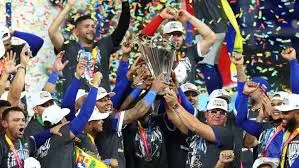
When Eugenio Suárez lined a go-ahead RBI double into the gap in the top of the ninth inning at loanDepot Park in Miami on March 19, 2026, it was not just a baseball play. It was a cultural moment. Venezuela held a 2-0 lead into the eighth inning before Bryce Harper tied things up with a towering two-run home run in the bottom of the frame. But the game wasn’t tied for long as Eugenio Suárez slugged a clutch double in the top of the ninth to put Venezuela back in front. Daniel Palencia then shut the door in the bottom of the ninth to seal the first World Baseball Classic title in Venezuela’s history.
When the most important baseball game in their country’s history was over and World Baseball Classic gold medals dangled around their necks, the members of the Venezuelan national team took the stage in center field at LoanDepot Park and belted every word to “Gloria Al Bravo Pueblo.” Some cried with the lyrics of their national anthem. The thousands of people still in the stands to celebrate the country’s first WBC title sang with them, tears streaming down many of their faces too.
It was a fitting, emotionally overwhelming finale to what became widely regarded as the greatest World Baseball Classic in the tournament’s 20-year history. And it immediately sparked a conversation that has been building for years: could the World Baseball Classic midseason tournament — which has always been played during spring training — one day move to the middle of the MLB season? Could it become a true midsummer classic for all of baseball? MLB Commissioner Rob Manfred and many of the sport’s biggest stakeholders now believe the answer is yes.
Record-Breaking Numbers: The WBC Has Arrived
Before diving into the midseason debate, it is essential to understand just how dramatically the 2026 World Baseball Classic midseason tournament exceeded every expectation set for it. The numbers are staggering.
This year’s WBC drew 1,619,839 fans for 47 games, a 24% increase over the previous high of 1,306,414 in 2023. The initial tournament in 2006 drew 740,451 for 39 games. In two decades, the WBC has more than doubled its attendance — a remarkable trajectory that few sporting events can match.
The television numbers were equally jaw-dropping. The United States-Mexico World Baseball Classic pool play game averaged 5.02 million viewers on FOX and Fox Deportes, marking the largest audience for any game in the history of the event across six editions dating back to 2006. And that was just a pool play game. The tournament was only getting started.
When the knockout rounds arrived, the numbers exploded. An audience of 7.369 million viewers took in Team USA’s thrilling 2-1 win over the Dominican Republic in the semifinals on FS1 and FOX Deportes, making it the most-watched WBC broadcast in tournament history. To put that in perspective, the game delivered one of the ten largest baseball audiences of the past year — trailing only the seven Dodgers-Blue Jays World Series games and surpassed last year’s MLB All-Star Game at 7.2 million.
Seven. Point. Three. Seven. Million. A taut 2-1 victory for Team USA over the Dominican Republic became the most-watched WBC game in history by a country mile, beating the prior record by 47%. It aired on FS1, not even the main Fox broadcast network, and still outpaced the March Madness selection show, the Players Championship, and ran alongside The Oscars. Baseball was the main character.
The most-watched 2006 matchup was Mexico’s second-round win over the U.S. at 2.46 million on ESPN. “There’s no resemblance to where we started in 2006,” said Commissioner Manfred. The transformation has been total and undeniable.
Manfred’s Vision: A Midseason World Baseball Classic
Fresh off witnessing the tournament’s greatest commercial and cultural success, Commissioner Rob Manfred did not waste time connecting the dots. Speaking to the Associated Press just one day after Venezuela’s title victory, Manfred made his most direct comments yet about moving the WBC to the middle of the MLB season.
“As the game continues to evolve, we have talked about midseason tournaments in general. And certainly if we decided to get serious about this, about a midseason tournament, this would be an ideal opportunity,” Manfred said.
The commissioner was equally candid about the next edition’s timing. “The issue for us is whether we do it in ’29 or in ’30, three years or four years? I’m getting a lot of email from people today saying don’t make us wait four more years for this,” Manfred said. “I do think a three- or four-year cycle is probably about right for the event. The timing is going to turn on what we do with respect to related sorts of international efforts. I remain optimistic about the Olympics.”
There is also a practical scheduling consideration standing between the dream and reality. “Obviously we have commitments to Fox in terms of the All-Star Game in the middle of the season through ’28,” Manfred acknowledged. Those broadcasting commitments mean a midseason WBC is not an immediate possibility, but the direction of travel is unmistakably clear.
The Core Problem: Spring Training Restrictions Are Hurting the Product
The argument for moving the WBC to midseason is not just about maximizing television ratings — though that is certainly a compelling factor. The deeper issue is that the current spring training format allows MLB clubs to place significant restrictions on how their players are used, and in some cases to prevent star players from participating altogether.
A midseason tournament would likely lead to fewer stars declining or being held back. Two-time AL Cy Young Award winner Tarik Skubal agreed with Detroit to be limited to one appearance, and the U.S. started 24-year-old rookie Nolan McLean in the final. Think about that for a moment: the United States started a 24-year-old rookie in the championship game of the biggest international baseball tournament on Earth — not because better options were not available, but because those players were restricted by their clubs.
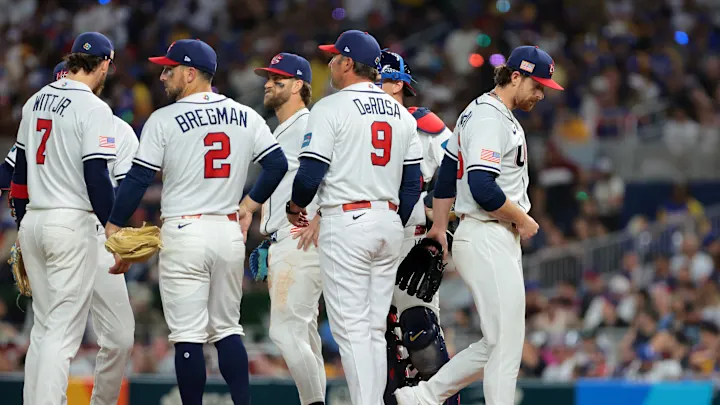
Closer Mason Miller was held out by U.S. manager Mark DeRosa, who promised the San Diego Padres he would be used only in a save situation. The result was that Team USA went into the ninth inning of the World Baseball Classic final without their most dominant reliever available in a tie game — a situation that would be unthinkable in the MLB postseason.
Team USA manager Mark DeRosa himself was unequivocal about what a midseason move would mean: “Certainly if it was moved to the middle of the season, I don’t think you would have any nos for competing in it,” DeRosa said. That is perhaps the most powerful endorsement imaginable — from the man who just managed in the championship game and experienced firsthand the limitations of the spring training format.
The Ringer observed that throughout the World Baseball Classic, no American hitter struggled quite like Bryce Harper. While other teams danced in the dugout, waved flags, and turned every big moment into a celebration, the Americans often looked buttoned up. They looked like a group of All-Stars assembled for a midseason series. Ironically, perhaps looking like a midseason all-star team is exactly the problem the WBC needs to solve — by actually becoming a midseason competition where players are fully prepared and their clubs have no leverage to restrict them.
Venezuela’s Story: Why the WBC Matters Beyond Baseball
The story of Venezuela’s 2026 triumph cannot be told without acknowledging the extraordinary political context in which it unfolded. The finalists walked onto the field in a single file from each outfield corner during an elaborate pregame ceremony. They arrived to play a game between baseball powers when it was impossible to ignore the recent political tumult between the two countries. On January 3, the United States successfully conducted a military strike to capture Venezuela President Nicolás Maduro and his wife. They were transported to the U.S. and charged with crimes while Delcy Rodríguez, Maduro’s vice president, became acting president of Venezuela.
In that charged atmosphere, Venezuela’s players carried something far greater than a baseball trophy on their shoulders. Salvador Perez said: “The World Series, as everyone knows, is one of the most important championships that the major leagues has. But when you play for your country, it’s a little bit beyond that. That feeling, the country where you were born and raised, the sacrifices your parents make, the people who helped you. That’s why this means a lot to me and a lot to Venezuela too.”
Maikel García was named the most valuable player of the tournament. The No. 2 hitter in Venezuela’s lineup, García paced all hitters with 10 hits. The young third baseman’s game-winning hit against Italy in the seventh inning of the WBC semifinals was the defining moment of the tournament.
The Tournament’s Biggest Moments
Venezuela Stuns Japan in the Quarterfinals
Japan was the defending champion, having defeated the United States in the 2023 WBC championship game, but was eliminated by the eventual champion Venezuela in the quarterfinals. Japan’s failure to reach the semifinals was its worst-ever finish in tournament history. The upset sent shockwaves through the baseball world and removed the tournament’s most bankable international star from the bracket.
Italy’s Stunning Upset of Team USA
Team USA’s advancement out of pool play was more nerve-wracking than expected. The Americans shockingly lost to Italy and set up a scenario where their quarterfinal fate was out of their hands. Italy, though, finished off a perfect round of pool play by beating Mexico to earn first place in Pool B. Italy’s win over Mexico prevented the Americans from being eliminated.
Aaron Nola, after the worst year of his career in 2025 for the Phillies, was dominant, throwing a tournament-high nine innings and allowing just one run across two starts. A rotation anchored by Nola, Michael Lorenzen, and Sam Aldegheri gave Italy legitimacy in a deep tournament run.
Italy stunning the United States 8-6 was the WBC’s signature upset of 2026, and even in defeat, Team USA drew a crowd. With 2.07 million viewers, it became the most-watched WBC pool play telecast on FS1 ever, peaking at 2.4 million. Chaos, as it turns out, is very good for ratings.
The All-Tournament Team
The All-Tournament team was dominated by the finalists, with Venezuela’s Maikel García (WBC MVP, .385 BA, 10 hits), Ezequiel Tovar (.471 BA, 8 hits), and the Dominican Republic’s Austin Wells (2 HR, 1.086 OPS) among the standouts. For Team USA, Roman Anthony (.920 OPS, 2 HR) and Brice Turang (8 hits in 22 at-bats) earned recognition despite the loss.
The Olympics Question: A Complicated Scheduling Puzzle
One of the key factors shaping the WBC’s future is baseball’s pursuit of Olympic inclusion. MLB and the players’ association are now negotiating whether big leaguers will participate in the 2028 Los Angeles Olympics. The six-nation baseball tournament, which includes the U.S., Dominican Republic and Venezuela, would be played during an extended All-Star break.
This creates a genuinely complex scheduling situation. If baseball returns to the 2028 Olympics — which would be played on American soil, creating enormous commercial potential — the proximity between that event and a potential 2029 WBC becomes a logistical headache. Manfred acknowledged: “I remain optimistic about the Olympics and obviously if we play in the Olympics it’s a short time from July of ’28 ’till the spring of ’29 and that’s something we’ll have to take into account.”
The solution many observers are now proposing is elegant in its simplicity: move the WBC to midseason, establish a clear four-year cycle aligned with the Olympics, and create a permanent calendar for international baseball that gives every tournament its proper place in the sport’s global rhythm.
What a Midseason WBC Would Look Like
Practically speaking, a midseason WBC would require a significant restructuring of the MLB schedule — something the league has already shown it is willing to do when commercial incentives are strong enough. The expanded All-Star break used for the 2028 Olympics provides a direct template.
A two-week window carved out of the MLB season in, say, late June or early July would give all 20 participating nations access to their best players at full competitive readiness. Pitch count restrictions — one of the most contentious elements of the current spring training format — would become far less relevant when pitchers are already built up to full innings loads. Club resistance to player participation would almost certainly evaporate.
The current geopolitical situation between the United States and Venezuela certainly cannot hurt viewership. While the situations are different, hockey’s 4 Nations tournament in 2025 seemed to see a viewership boost because of disagreements between the governments of Canada and the United States. A midseason WBC, played at the height of the baseball season when fans are most engaged with the sport, could realistically push viewership numbers well beyond 10 million for marquee games — figures that would make network executives and sponsors salivate.
Baseball’s Undeniable Global Growth
The 2026 World Baseball Classic completed what three years ago felt like a work in progress. The WBC gives international baseball a spot on the sports map next to the Olympics and the World Cup and reveals a version of the sport that feels louder and more urgent than the one we watch most of the year. For two weeks every three years, the sport sheds its leisurely pace and turns into a high-stakes and emotionally charged spectacle rivaled only by October in intensity — at least in Major League Baseball.
The numbers don’t lie, and they’ve been telling the same story for three tournaments in a row. The World Baseball Classic is no longer a March curiosity. It’s a cultural event, a ratings powerhouse, and for a growing generation of baseball fans, it’s the most exciting thing the sport does.
The WBC’s ownership structure also ensures that all major stakeholders are financially aligned in wanting the tournament to succeed. MLB and the players’ association have matching equity shares that are the most in the WBC, with Nippon Professional Baseball, the Korea Baseball Organization, and the World Baseball Softball Confederation owning minority stakes.
Conclusion: The Future Is Bright — and Probably Midseason
Venezuela’s triumph in Miami on March 17, 2026, was about far more than baseball. It was about national identity, human resilience, and the unifying power of sport in a divided world. And for the game of baseball itself, the 2026 World Baseball Classic was proof that the sport’s future — international, emotionally charged, and commercially vibrant — is brighter than it has been in decades.
The question of whether the WBC moves to midseason is no longer a fringe idea debated by a handful of executives in private meetings. It is a live, serious conversation being led by the Commissioner of Baseball himself, backed by record attendance and television figures, and endorsed by the managers and players who compete in it.
The best part? It’s only going to get bigger. Whether the next World Baseball Classic comes in 2029 or 2030, whether it stays in spring training or finally makes the leap to midseason, one thing is abundantly clear: global baseball is having its moment — and it is not going away.