| F1 2026 SEASON — AT A GLANCE | |
| Season Opener | Australian Grand Prix, Melbourne — March 2026 |
| New Teams | Cadillac F1 joins — 22 cars on the grid |
| Power Unit | 1.6L V6 Turbo Hybrid — 50/50 ICE/Electric split |
| Minimum Weight | 768 kg (down from 800 kg) |
| Fuel | 100% Advanced Sustainable Fuel |
| DRS | Abolished — replaced by Active Aero & Overtake Mode |
| New World Champion | Lando Norris (McLaren) — 2025 |
| Budget Cap | $215 million (up from $135 million) |
What are the new F1 rules for 2026 season?, Formula 1 entered 2026 with what many are calling the most sweeping and ambitious technical revolution in the sport’s history. Affecting every single element of the car — from its engine and aerodynamics to its weight, dimensions, fuel, and software — the new regulations represent a fundamental reimagining of what a Formula 1 car can and should be.
Read more sports insights on SportsTab.
The changes have been years in the making. After the ground-effect era that kicked off in 2022 produced increasingly aero-sensitive cars that became harder to follow on track, the FIA and Formula 1 went back to the drawing board to create regulations that would promote closer, more exciting racing, push the sport toward sustainability, and attract new manufacturers to the grid.
As Lewis Hamilton put it during pre-season testing in Bahrain: “It’s ridiculously complex. I sat in a meeting the other day and they’re taking us through it, and it’s like you need a degree to fully understand it all.” With that in mind, here is your comprehensive breakdown of every key rule change you need to know about for 2026.
Smaller, Lighter, More Nimble Cars
The ‘Nimble Car Concept’
One of the most immediately visible changes What are the new F1 rules for 2026 season? is that the cars are simply smaller. The FIA introduced what it calls the “Nimble Car Concept” — a deliberate reduction in the physical dimensions of the cars to create more agile machines that are easier to race wheel-to-wheel, particularly on the narrow street circuits like Monaco and Singapore.
Visit Sportsurge for the latest sports updates.
Wheelbase: Reduced by 200mm — from 3,600mm to 3,400mm, making the car noticeably shorter and more responsive through corners.
Track Width: The car is 100mm narrower, giving fractionally more room for two cars to race side-by-side.
Tyre Width: Front tyres are 25mm narrower; rear tyres are 30mm narrower. This reduces drag, trims weight, and slightly reduces the contact patch.
Minimum Weight: Dropped from 800 kg to 768 kg — a significant 32 kg saving. Drivers have already noticed the improvement in handling despite lower downforce levels.
The smaller wheel arches, removal of wheel covers, and other aerodynamic simplifications all contribute to a cleaner, more nimble visual silhouette. Reaching the 768 kg minimum weight has proven challenging in practice due to heavier batteries and complex power units, but the intent is clear — lighter, more dynamic cars.
Active Aerodynamics — Goodbye DRS, Hello Active Wings
The End of DRS
For over a decade, the Drag Reduction System (DRS) was one of Formula 1’s most recognisable overtaking aids — a simple rear wing flap that opened on designated straights to allow a chasing car to close a gap. In 2026, DRS has been completely abolished and replaced by a far more sophisticated system: fully Active Aerodynamics.
How Active Aero Works
The 2026 cars feature dynamically adjustable angles on both their front and rear wing elements, switching between two distinct configurations depending on where the car is on the circuit:
Corner Mode: Wings are in their default closed position, maintaining maximum downforce through corners to preserve grip and stability.
Straight-Line Mode: On designated straights, the flaps open and the wings flatten out, dramatically reducing drag and boosting top speed. Unlike DRS, this is available to every driver on every lap — there is no requirement to be within one second of the car ahead.
The transitions between these two modes are strictly controlled by the FIA Standard ECU, preventing teams from exploiting the system or programming infinitely adjustable aero elasticity.
The Floor Revolution
Underneath the car, the famous Venturi tunnels that generated massive ground-effect downforce in the 2022-2025 era have been removed. In their place: a flatter floor with an extended diffuser featuring larger openings. This means less total downforce and a higher ride height requirement — but crucially, the new aerodynamic philosophy is designed to produce cleaner wake from the rear of the car. According to the FIA, a car running 20 metres behind a rival in 2026 will retain approximately 90% of its total downforce, compared to just 70% by the end of the 2025 season. That dramatic improvement should make following and overtaking considerably more viable.
The front and rear wings have been significantly simplified compared to the elaborate multi-element designs of recent years. New bargeboards are designed to direct turbulent airflow from the front wheels inward rather than outward, reducing the “outwash” that has traditionally blasted disturbed air toward the car behind.
Revolutionary New Power Units — The 50/50 Split
A New Engine Formula
The 2026 power unit regulations represent the most significant engine change since the hybrid V6 formula was introduced in 2014. While the core architecture remains a 1.6-litre V6 turbocharged engine, almost everything else has changed.
The Key Change: The internal combustion engine’s output has been significantly cut, while the electrical motor output has tripled. The result is an approximate 50-50 power split between petrol and electric — meaning roughly half of the car’s power at any given moment is coming from an electric motor.
Goodbye MGU-H
The complex and expensive MGU-H (Motor Generator Unit — Heat), which recovered energy from the exhaust heat and turbo, has been completely removed. This component was notoriously difficult and costly to develop, and its limited road-relevance made it an obstacle to attracting new manufacturers to the sport. Its removal significantly simplifies the hybrid system while also dropping weight.
A Doubled ERS
In place of the MGU-H, the Energy Recovery System (ERS) has been significantly upgraded. The new ERS can harvest twice as much energy per lap as it could in 2025, with the capacity to recover up to 9 MJ (megajoules) per lap — double the previous limit. This energy is recovered under braking and during lift-off at the end of straights, replenishing the battery throughout the course of the lap.
This creates a fascinating new tactical dimension for drivers and engineers: managing when and how to harvest energy, and when to deploy it, becomes a critical strategic element that can make the difference between winning and losing.
New Manufacturers Join the Grid
The 2026 power unit regulations were deliberately designed to attract new manufacturers to Formula 1 — and it worked. The new engine formula has brought in Audi as a full constructor (entering from 2026), Ford as a partner to Red Bull Power Trains, and confirmed Honda’s return as a standalone engine supplier after a brief absence. General Motors/Cadillac will join as an engine manufacturer from 2029. Established suppliers Ferrari and Mercedes also completely redesigned their units from scratch to meet the new regulations.
100% Advanced Sustainable Fuel
For the first time in the sport’s history, every Formula 1 power unit in 2026 runs on 100% Advanced Sustainable Fuels. These fuels were trialled successfully in the feeder series Formula 2 and Formula 3 during 2025 before being introduced at the top level.
The fuel is derived from cutting-edge sustainable sources including carbon capture, municipal waste, and non-food biomass. It is independently certified to meet strict sustainability standards and forms a core part of Formula 1’s goal to achieve carbon neutrality by 2030. Crucially, Advanced Sustainable Fuels can also be used in conventional road cars, meaning the technology developed in the world’s most demanding racing series has direct potential for real-world environmental impact.
There were some early complications — ahead of the season-opening Australian Grand Prix, Mercedes and Aston Martin’s fuel suppliers (Petronas and Aramco respectively) had not yet received FIA homologation. This was resolved before the race, with Mercedes’ fuel confirmed as approved in time for Melbourne.
Overtake Mode — The New Racing Battleground
Replacing DRS With Strategy
With DRS gone, Formula 1 needed a new mechanism to help chasing drivers make overtaking moves. Enter: Overtake Mode. This brand-new system introduces an entirely different and more strategic approach to gaining positions on track.
How Overtake Mode Works
When a driver gets to within one second of the car ahead at a designated Detection Point on the track, they unlock Overtake Mode for the entire following lap. In this mode, the attacking driver can harvest an extra 0.5 MJ of electrical energy and deploy a higher electrical power profile, allowing them to sustain a higher speed for a longer period. This mode is particularly useful for defending positions too — a driver who knows they are being chased can enter Overtake Mode themselves to build a gap before they can be passed.
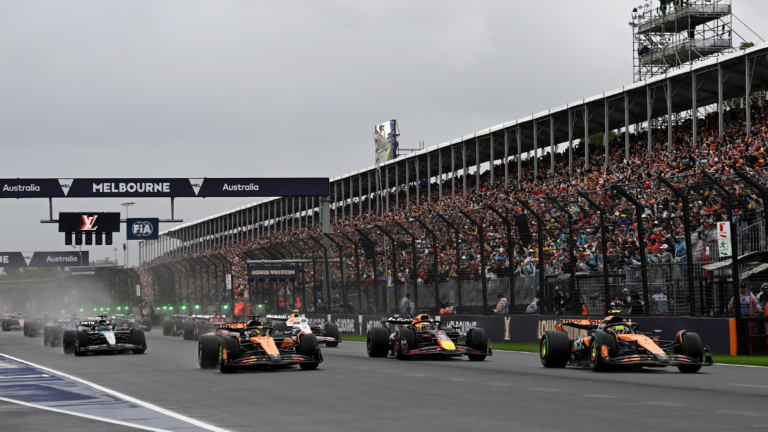
The result, as witnessed in the opening 2026 Australian Grand Prix, is a radically different style of racing. George Russell and Charles Leclerc traded the lead seven times in nine laps in the early phase of the race, with varying energy levels causing dramatic differences in straight-line speed at different points on the circuit. Ferrari team principal Frederic Vasseur said: “Honestly, the first 10 laps of the race, I’m not sure that I saw something like this in the last 10 years.”
The ‘Boost Button’ and Energy Controls
Drivers also have access to a “Boost Button” that allows manual control of energy deployment during overtaking or defending situations. Additionally, drivers can manage lift-off regeneration — lifting off the throttle triggers energy harvesting, but this disables the Active Aero devices simultaneously. A process called “super clipping” tops up the battery at full throttle, keeping the Active Aero systems fully operational. This complex interplay of energy management and aerodynamic behaviour creates a rich tactical landscape that rewards strategic thinking as much as raw pace.
Significantly Enhanced Safety Standards
Stronger Survival Cell
No major regulation change in Formula 1 is complete without a step forward in safety, and 2026 is no different. The drivers’ survival cell has been subjected to more rigorous crash tests, and the roll hoop — the structure behind the driver’s head that protects them in a rollover — must now withstand up to 20G of force, up from 16G. That is equivalent to the roll hoop supporting roughly the weight of nine family cars in a vertical impact test.
Two-Stage Nose Cone
A significant new safety innovation for 2026 is the two-stage nose cone design. In a heavy frontal impact, the nose cone shears off as designed to absorb energy — but the new two-stage system continues to offer meaningful structural protection after the initial impact in the event of a secondary collision, such as when a car bounces off a barrier and is struck again. Side-impact protection around the driver and fuel cell has also been tightened.
ERS Status Lights
A new set of external lights on the 2026 cars indicates the status of the Energy Recovery System, functioning similarly to hazard lights on a road car. This allows other drivers and marshals at the circuit to quickly understand whether a car’s high-voltage ERS is active — a critical safety feature that reduces the risk of dangerous situations when cars are stopped on track.
New Sporting Regulations — Qualifying, Grid & Penalties
22 Cars on the Grid
The arrival of the Cadillac Formula 1 team for 2026 has expanded the grid to 22 cars — the largest in the modern era. This has necessitated adjustments to the qualifying format to accommodate the additional entries.
Revised Qualifying Elimination
With 22 cars competing, the Q1 and Q2 elimination format has been updated. Six cars will now be eliminated at the end of Q1 (up from five), and a further six will drop out at the end of Q2 (up from five). Q3 continues with the remaining 10 drivers competing for pole position on a 12-minute shootout.
Updated Penalty Point System
One of the most welcomed changes among the driver fraternity is a reform of the penalty point system. The previous system had come under widespread criticism for distributing points too freely, with Max Verstappen, Lando Norris, and others regularly hovering dangerously close to a race ban despite committing what many felt were routine racing incidents. Kevin Magnussen actually triggered a ban in 2024, and current Haas driver Ollie Bearman enters 2026 just two points short of the 12-point threshold.
From 2026, penalty points will only be issued for incidents deemed dangerous, reckless, or deliberate — specifically collisions caused by such behaviour, or incidents of unsportsmanlike conduct. Stewards have been granted greater flexibility and leniency in borderline cases, meaning ordinary racing incidents that do not result in collisions are far less likely to result in penalty points going forward.
Overhauled Track Limits & Overtaking Guidelines
The FIA has also updated its guidelines on track limits and overtaking rules in chicanes and complex corner sequences. A new provision allows stewards to consider “other factors such as the sequence of corners holistically” when evaluating a driver’s right to a corner — giving officials more freedom to make contextual judgements rather than rigidly applying technicalities to complex racing situations, a long-standing complaint from drivers.
Revised Race Start Procedure
A small but important change has been made to the race start procedure. Once the final car has taken its grid slot, drivers receive a pre-start warning. From that point, they have five seconds to begin building revs before the first starting light is illuminated. Simulations during pre-season testing in Bahrain had identified a potential safety concern with the previous procedure — particularly around the potential for dangerous closing speed differentials with the new Straight-Line Mode at race starts — prompting the race director to implement this refinement ahead of Melbourne.
A Much Larger Budget Cap
The 2026 regulations brought with them a very significant increase in the Cost Cap — the financial ceiling that governs how much teams can spend on car development and operations. The main budget cap has risen from $135 million to $215 million for 2026, reflecting the enormous investment required to design and build entirely new cars under the radical new regulations.
The Power Unit Cost Cap has also been substantially increased, from $95 million to $130 million, to account for the complete redesign of engines required under the new rules. These increases are intended to be a one-time adjustment to help teams transition to the new formula, with the expectation that the cap will be reviewed and tightened again once the initial development cycle stabilises.
How Has It Played Out? — Early 2026 Season Reactions
The opening round of the 2026 season at the Australian Grand Prix provided the first real-world data on how the new regulations perform in competition. The results were mixed but undeniably dramatic.
George Russell claimed victory for Mercedes from teammate Kimi Antonelli, with Charles Leclerc third and Lewis Hamilton fourth. The race produced a remarkable 120 overtakes — and the early laps featuring the Russell-Leclerc battle were genuinely spectacular, with the lead changing hands multiple times due to the Overtake Mode system and varying energy levels.
However, not all feedback was positive. Lando Norris, who finished fifth, expressed frustration with the unpredictability of the new power unit behaviour, suggesting the sport had gone “from having its best cars to potentially its worst with this new ruleset.” Max Verstappen — who had previously labelled the formula “anti-racing” and “Formula E on steroids” — had a difficult weekend, and the Red Bull-Ford package appeared to struggle relative to Mercedes.
F1 bosses and the FIA acknowledged that some elements of the new rules, particularly around energy harvesting and deployment levels, may not be perfectly calibrated. A timeline for potential tweaks was agreed between F1, the FIA, and the teams in the gap between Bahrain testing and the Australian GP — with talks scheduled after the Chinese Grand Prix to evaluate what adjustments, if any, should be made. As Williams team boss James Vowles noted: “I think the worst thing we can do is change it and make it worse.” The consensus is that the new rules deserve time to bed in before any rushed modifications are considered.
Summary: F1 2026 Rule Changes at a Glance
| Area | 2025 (Old) | 2026 (New) |
| Min. Weight | 800 kg | 768 kg |
| Wheelbase | 3,600 mm | 3,400 mm |
| Power Split | ~80% ICE / 20% ERS | ~50% ICE / 50% ERS |
| MGU-H | Present (expensive) | Removed entirely |
| ERS Harvest | 4.5 MJ / lap | Up to 9 MJ / lap |
| Overtaking Aid | DRS (rear flap) | Active Aero + Overtake Mode |
| Fuel | 10% sustainable blend | 100% sustainable fuel |
| Floor Design | Venturi tunnels (ground effect) | Flat floor + bigger diffuser |
| Cars on Grid | 20 | 22 (Cadillac added) |
| Q1 Elimination | 5 cars out | 6 cars out |
| Budget Cap | $135 million | $215 million |
| PU Cost Cap | $95 million | $130 million |
Conclusion: A New Era, For Better or Worse
The 2026 regulations mark a genuine watershed moment for Formula 1. The combination of smaller, lighter cars, active aerodynamics, a 50-50 hybrid power split, sustainable fuels, and a completely new overtaking system represents a bet by Formula 1 and the FIA that the future of the sport must be simultaneously more exciting on track and more relevant to the real world.
The early signs from Australia are simultaneously promising and uncertain. The racing in the opening laps was unlike anything seen in years — lead changes driven by energy management rather than tyre strategies or overtaking around the outside made for genuinely unpredictable entertainment. Yet concerns remain about whether the balance of power and energy in the rules is correctly calibrated, and whether the cars are truly better to drive and race than their predecessors.
What is beyond doubt is that 2026 represents the most daring technical gamble in the modern era of Formula 1. The teams that master the new power units and energy management systems earliest will likely dominate. And with five different engine manufacturers now competing at the highest level — Ferrari, Mercedes, Honda, Red Bull-Ford, and Audi — the diversity of the competition has never been greater.
One thing is certain: Formula 1 in 2026 is not the sport it was twelve months ago. Buckle up.