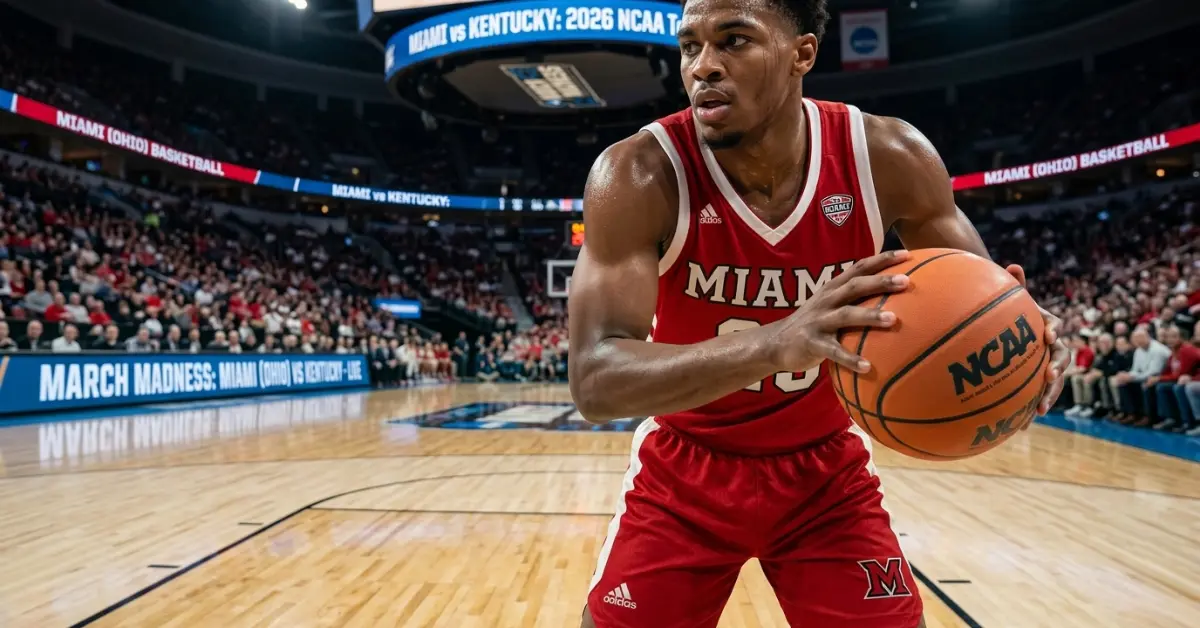
College basketball loves a story Miami (Ohio) and the 2026 NCAA Tournament, And in the winter and early spring of 2026, no story in the sport has been bigger, more debated, or more layered than the Miami (Ohio) RedHawks. A team from a mid-major conference in the heart of Ohio went 31-0 through the regular season — the first unbeaten regular-season run in college basketball in five years — and still couldn’t walk into the NCAA Tournament with the same confidence most teams carry after losing just once in a month.
Then, on Thursday morning in Cleveland, the RedHawks were handed the most brutal kind of punctuation: a first-round exit from the MAC Tournament at the hands of UMass, a team that had lost six of its last seven regular-season games.
So, is Miami (Ohio) in the 2026 NCAA Tournament? Almost certainly yes — but nothing is guaranteed yet, and the next 72 hours will be among the most uncomfortable in program history.
The Perfect Season That Wasn’t Supposed to Be
When Travis Steele’s RedHawks opened their 2025-26 schedule, nobody outside of Oxford, Ohio had them circled as a potential history-maker. Steele, who has quietly built one of the most successful mid-major programs in the country, returned the bulk of a roster that went 25-10 the prior season. Good foundation, sure. Unbeaten regular season? Nobody saw that coming.
But game by game, win by win, Miami refused to lose.
The RedHawks built their undefeated record on balance and depth rather than any single star. Five players averaged in double figures: guard Peter Suder at 14.8 points per game (the MAC Player of the Year), Brant Byers at 14.1, Eian Elmer at 12.5, Luke Skaljac at 10.3, and Almar Atlason at 10.5. No opponent could key on one player and shut Miami down, because by the time they did, another Redhawk was stepping up.
The team also led the entire nation in scoring, putting up an extraordinary 92.3 points per game. That is not the profile of a plodding mid-major trying to grind out results — that is a team playing with elite offensive tempo and rhythm. For a program in the MAC, those numbers were otherworldly.
The low point — if you could even call it that — came on December 20 at Ball State, when starting point guard Evan Ipsaro tore his ACL. Ipsaro was averaging 13.9 points per game and was the engine of Miami’s offense. Most programs would have buckled. Miami didn’t drop a game. Sophomore Luke Skaljac stepped into the starting lineup and averaged 13.3 points across 11 starts, scoring in double figures in nine of them. The RedHawks just kept rolling.
By the time February became March, Miami was the last unbeaten team in college basketball and ranked in the AP Top 25 at No. 19/20. They had gone 18-0 in MAC play, won the regular-season conference title outright, and earned the No. 1 seed in the MAC Tournament. Steele was named MAC Coach of the Year — unanimously. The university offered him a contract extension through the 2033-34 season that would make him one of the highest-paid coaches in the conference.
The Asterisk Nobody Wanted to Talk About (But Everyone Did)
For all the celebration, a persistent and fair question loomed: was Miami actually good enough for the NCAA Tournament on résumé merit, or were they simply racking up wins against inferior competition?
The numbers told a complicated story. Miami’s NET strength of schedule was ranked No. 339 nationally — essentially dead last. The RedHawks had zero Quad 1 wins and only two Quad 2 victories all season. Those categories matter enormously to the NCAA Tournament Selection Committee, which evaluates teams not just on record but on the quality of their opponents.
Meanwhile, Miami’s KenPom rating entering the MAC Tournament sat at No. 91 — a number that, in any normal year, would have placed them well outside at-large consideration. Akron, the conference’s No. 2 seed and a team that lost to Miami back in January, ranked No. 61 in KenPom, a full 30 spots higher.
For context: the 2013-14 Wichita State team that entered the NCAA Tournament at 34-0 carried a KenPom ranking of No. 5. They had beaten BYU, Saint Louis, Tennessee, and Alabama in non-conference play. Miami’s non-conference slate simply wasn’t in the same universe.
ESPN bracketologist Joe Lunardi had Miami projected as a No. 10 seed entering the conference tournament. CBS Sports Bracketology slotted them at the same spot. The sentiment from most national analysts was consistent: Miami was in — but barely, and with a seeding that reflected skepticism about their schedule rather than admiration for their record.
MAC commissioner Dr. Jon Steinbrecher made his own position clear when he told reporters in Cleveland Monday that Miami “should be in” the NCAA Tournament, citing what he characterized as one of the most impressive performances in recent mid-major history. Coming from the man who runs the conference, those words carried weight — though they weren’t his decision to make.
Thursday’s Earthquake: UMass Stuns the Nation’s Last Unbeaten
If the week leading up to the MAC Tournament was uncomfortable for Miami fans, Thursday morning at Rocket Arena in Cleveland was something much worse.
The No. 8 seed Massachusetts Minutemen — 16-15 on the season, ranked No. 204 in the NET — came out of the first round of the MAC Tournament and beat the No. 1 seed RedHawks, 87-83, ending Miami’s perfect season in the most abrupt and painful way possible.
The damage went beyond the final score. UMass dominated the glass, finishing with a staggering 41-24 rebounding advantage that led to a 24-point edge in points in the paint. Miami, a team built on guard play and offensive efficiency, was simply outmuscled physically.
The loss came barely 48 hours after broadcaster after broadcaster had debated Miami’s NCAA Tournament résumé. Now, they had lost to a team with 15 losses — in the first round of their own conference tournament — and the debate became far more urgent.
So, Are They In?
Despite the gut-punch loss, the early consensus from bracketologists is still: yes, Miami (Ohio) will be in the 2026 NCAA Tournament field.
CBS Sports updated its bracketology projections within hours of the loss, dropping the RedHawks from the No. 10 seed line to No. 11, but keeping them in the field. The projection also noted they may avoid the First Four in Dayton depending on how the rest of the weekend shakes out.
Prediction market platform Kalshi Sports placed Miami’s odds of making the tournament at 71% as of Thursday afternoon — down significantly from before the loss, but still comfortably above a coin flip.
What works in Miami’s favor is a simple historical argument: since the NCAA Tournament field expanded to 64 teams in 1985, not a single team with two or fewer losses has been left out of the bracket. That is a 2,616-0 precedent. Leaving out a 31-1 team would be genuinely unprecedented in the modern era of the tournament.
What works against them is the context of the loss itself. Miami didn’t fall to a tough mid-major in a neutral-site game. They lost to a team with 15 losses that had dropped six of its previous seven contests. The selection committee, which values strength of schedule heavily, will now have one more piece of ammunition for skeptics — a bad loss on top of a weak schedule.
Still, as CBS Sports noted, the saving grace for Miami is the weakness of this year’s overall bubble. Many teams that could theoretically push the RedHawks out of the field have struggled in their own conference tournaments, failing to distinguish themselves as clearly stronger at-large candidates.
A Silver Lining for the MAC — and a Fascinating Side Story
There is a delicious irony embedded in Miami’s exit. By losing to UMass, the RedHawks have made it nearly certain that the MAC will send two teams to the NCAA Tournament for the first time since 1999 — with Miami as the at-large bid and the MAC automatic qualifier coming from the rest of the bracket.
Akron is now the runaway favorite to win the MAC Tournament and claim that automatic berth. The Zips, led by MAC scoring leader Tavari Johnson (over 20 points per game) and versatile forward Amani Lyles, have won 16 consecutive MAC games since losing to Miami back on January 3. Akron head coach John Groce, now in his ninth season, has built one of the more consistent programs in the conference. The Zips rank in the mid-60s in KenPom — a profile that makes them a legitimate at-large team in their own right.
If Akron wins the MAC Tournament and Miami gets an at-large bid, it would mark a watershed moment for the conference — two teams dancing at once for the first time in a quarter century.
There is also one of the more unusual storylines in college basketball woven into this MAC drama: Travis Steele, Miami’s head coach, and John Groce, Akron’s head coach, are half-brothers. They faced each other in last year’s MAC Tournament title game too, a thriller that Akron won. The possibility of both programs reaching the NCAA Tournament — and perhaps meeting again — is one of the sport’s best human interest stories of the year.
What Happens Next
The MAC Tournament continues through the weekend, with Akron as the clear favorite. Meanwhile, Miami will watch from the sideline as Selection Sunday approaches. The committee will convene, review résumés, and make a call that will define the legacy of a 31-1 season.
The argument for Miami remains powerful. Thirty-one regular-season wins without a loss is extraordinary under any circumstances. The team lost their starting point guard to a torn ACL in December and kept winning. They led the nation in scoring. Their head coach won Coach of the Year. Their best player won Player of the Year. They went unbeaten in conference play.
The argument against is also real. Strength of schedule No. 339. Zero Quad 1 wins. Two Quad 2 victories. A first-round MAC Tournament loss to a team with 15 losses.
Former coaches who have lived through this exact debate — programs at Murray State, Valparaiso, Indiana State — know how the mid-major grinder works. The system, as Saint Louis head coach Josh Schertz told CNN, is not designed to be equitable. Power conference programs have structural advantages in scheduling and, consequently, in the metrics that matter most to the committee.
But history is history. No team with one loss has ever been left out since 1985. The selection committee would be making a genuinely historic — and almost certainly controversial — decision if they leave Miami out of the field.
Barring an extraordinary collapse of the bubble over the next three days, Miami (Ohio) should receive an at-large bid to the 2026 NCAA Tournament. It will likely come with a No. 11 seed and perhaps a First Four appearance in Dayton. It will come with debates, with asterisks, with national pundits arguing about what the RedHawks’ record really means. Travis Steele and his team have gotten used to those conversations all season long.
What they want now is the same thing they have wanted since November: a chance to prove their worth on the biggest stage in college basketball. Whether the selection committee agrees enough to give them that chance, the nation will find out on Sunday.